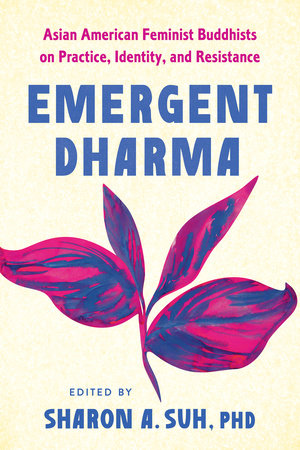
Emergent Dharma: Asian American Feminist Buddhists on Practice, Identity, and Resistance
Edited by Sharon A. Suh, Ph.D.
Publication date December 9, 2025
240 pp.
ISBN: 9798889842330
Emergent Dharma is a collection of essays from Asian American feminist writers, sharing their experiences as practitioners of Buddhism. These essays seek to identify what Asian American Buddhism is and how it relates to American Buddhism, to demonstrate what Buddhism looks like from an Asian American feminist approach and to legitimize Asian American Buddhist practices.
Ultimately, the essays form a collection that Asian American readers can resonate with, offering a reflection of them through these stories and creating a community and refuge for Asian American Buddhists.
The book offers different perspectives of Asian American Buddhism, from stories of Japanese American Buddhism and its focus on ancestor worship to Singhalese Buddhists practicing as a form of anticolonialism and as a way of reclaiming its culture and language.
In “Creating Desire Paths,” Mihiri Tillakaratne, a Sri Lankan American Buddhist, contemplates on her identity as a self-proclaimed “Bad Buddhist Auntie.” Her intention is to use Buddhism as a force for social justice. Tillakarantne sees no harm in questioning old traditions and making practices more fitting to modern life and thus more welcoming to the younger generation. To her, being a “Bad Buddhist Auntie” by providing a path for future generations to follow is being a good ancestor.
I especially resonated with “Grave Remembrance.” Jane Naomi Iwamura recounts memories of her mother, who passed away in 2001. She recalls visiting her grave, cleaning it, and interacting with her mom as if she were still alive. This is how Shin Buddhists practice remembrance, as a way to connect with those who have passed, a show of gratitude, care and respect, showing that caring and compassion extends far beyond this life. This remembrance is something that is traditionally practiced in Chinese cultures as well. Every April, my family and I engage in “Tomb Sweeping,” where we visit the sites of deceased family members to clean their graves and burn joss paper as well as incense, sending items they may need need to flourish in the afterlife and carrying messages to our loved ones about our hopes, wishes, and dreams.
Overall, I found it fascinating to learn from different cultures and perspectives, the many ways one could practice Buddhism. Sharing these stories from Asian American Buddhists enlightens readers of the long history of its practice, showing that we as Asian Americans inherently have the right to claim the legacy and legitimacy of Asian American Buddhism and its practices. As a reader, I resonated with many aspects of each essay. And as an Asian American, these pages felt like a place of refuge, an inclusive and welcoming sangha for Asian American feminist voices.
Review by Liza Ly with editing assistance by Emily Espanol. If you would like to write a book review, please email communications@apalaweb.org.
Book reviews and author interviews featured on APALAweb.org are reflective of the reviewer and interviewer only and are conducted separately from and independently of APALA and the APALA Literature Awards Committee and juries.