by Leialani Wihongi-Santos & Richard M. Cho
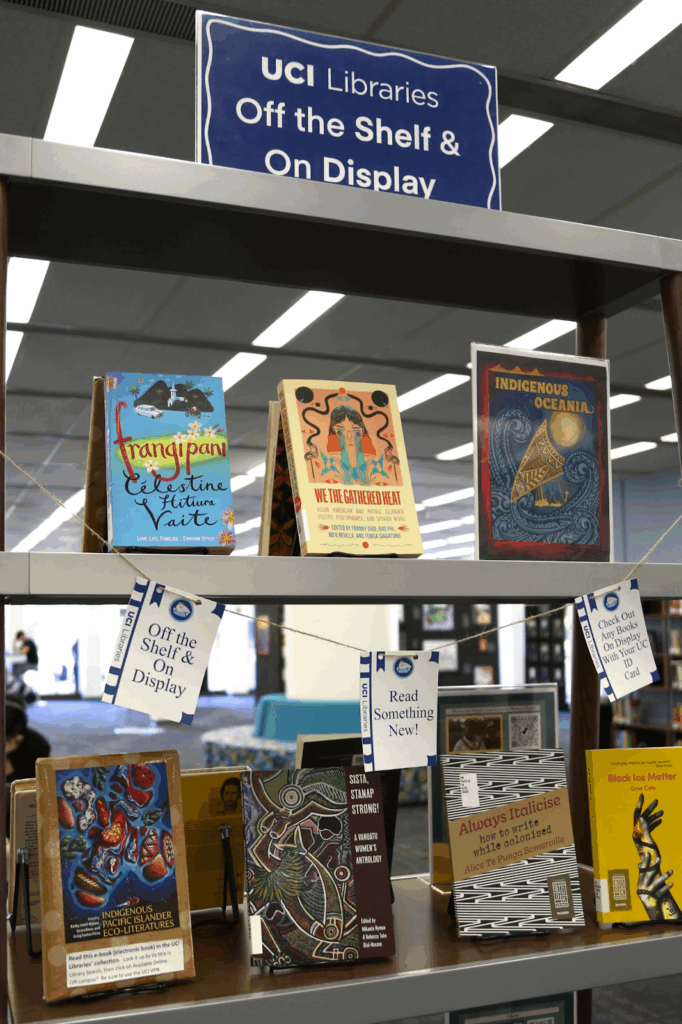
UCI Libraries Indigenous Oceania book display. Photo Credit: Kathy Tran
In November 2024, during the National Native American Heritage Month, two APALA members working at the Langson Library (one of the three libraries at University of California, Irvine) collaborated to curate a book display on the theme of Pacific Islander* authors. The project was inspired by the update in evaluation criteria for the APALA Literature Award that year, a step taken to be more inclusive. Titled “Indigenous Oceania,*” the book display incorporated a grassroots-style curation involving outreach to a student organization and campus staff of Pasifika* backgrounds. The event was deemed a success: students checked out the books on display while some even left written testimonies expressing gratitude for the sense of belonging they felt in the library.
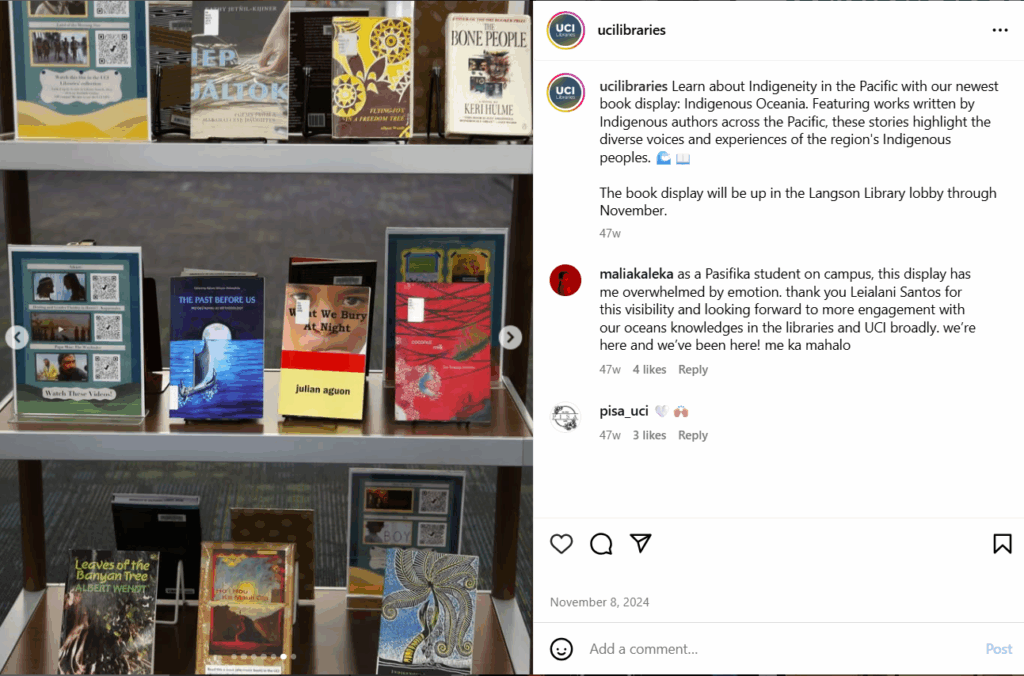
UCI Libraries’ Instagram post (slide 6) and comment section — featuring the back side of the book display.
With more than a million physical books available, the serendipitous discovery is rare in a typical university library because patrons usually do not venture into the labyrinth of towering stacks without already knowing what they are looking for, with an LOC call number on hand. In addition, many hardcovers have their illustrative dust jackets taken off, making the appearance of the books identical. One can say that books are “buried” in bookshelves.
Cue the book display in the lobby. Many libraries, both academic and public, make use of a book display, setting it up in the limelight. The most common themes include “Banned Books” and “Blind-Date-With-a-Book.” However, a book display can serve other various functions such as providing enhanced visibility to patrons on issues that are usually hidden from plain sight. At UC Irvine Langson Library, we have hosted a monthly book display in the lobby since 2017, with themes as varied as 1) “Performing Whiteness: An Examination of the Perpetuation of Racial Hierarchy,” 2) “Borders, Emotions and Imaginaries: Magnifying Immigrant Experiences and Immigrant Histories,” and 3) “Fateful Triangle: America’s Role in Israeli-Palestine Conflict.” Such displays not only bring more visibility to minority groups and controversial discourses but also facilitate collaborative and pedagogical endeavors amongst librarians, faculty members, and students.
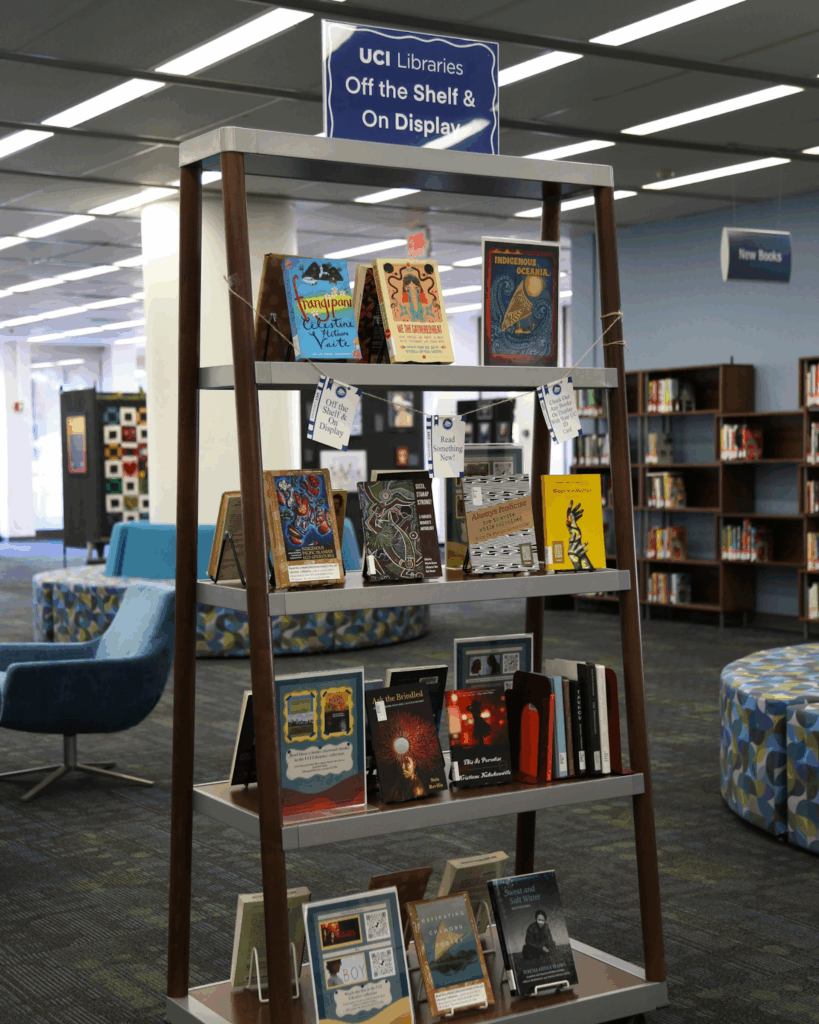
Front side of the Indigenous Oceania book display. Photo Credit: Kathy Tran
The challenge came early on, as we realized that the library had not collected many recently published books by authors from Pasifika backgrounds. In addition to consulting websites such as Pacific Islanders in Publishing, we decided to seek input from other organizations on campus. We set up a Google Sheet and shared its access with the Pacific Islander Student Association (PISA) and fellow Pacific Islander staff and faculty, so they could list books they personally would like to see in our collection.
In total, our list contained 42 titles of interest. From there, we went through the list— double-checking that UCI Libraries did not own a physical or digital copy of each request—then we purchased what remaining books we could. We set limits on certain genres such as young adult (YA) or romance, as students’ recommendations tend to lean on such genre-fiction. UCI Libraries owned only 19 of the 42 titles listed; we purchased 17 more, including Always Italicise: How to Write While Colonized by Alice Te Punga Somerville and Sweat and Salt Water by Teresia Kieuea Teaiwa, two critically acclaimed works both in and outside of the Pacific Islander community. In total, our book display consisted of 36 items, along with seven films available through UCI’s Kanopy subscription, which were all displayed beautifully thanks to the help of our student employees. They also helped us with designing the signage we used for e-books and films (and made sure to include QR codes and online access instructions), the book dummies for additional e-books, and the display poster.
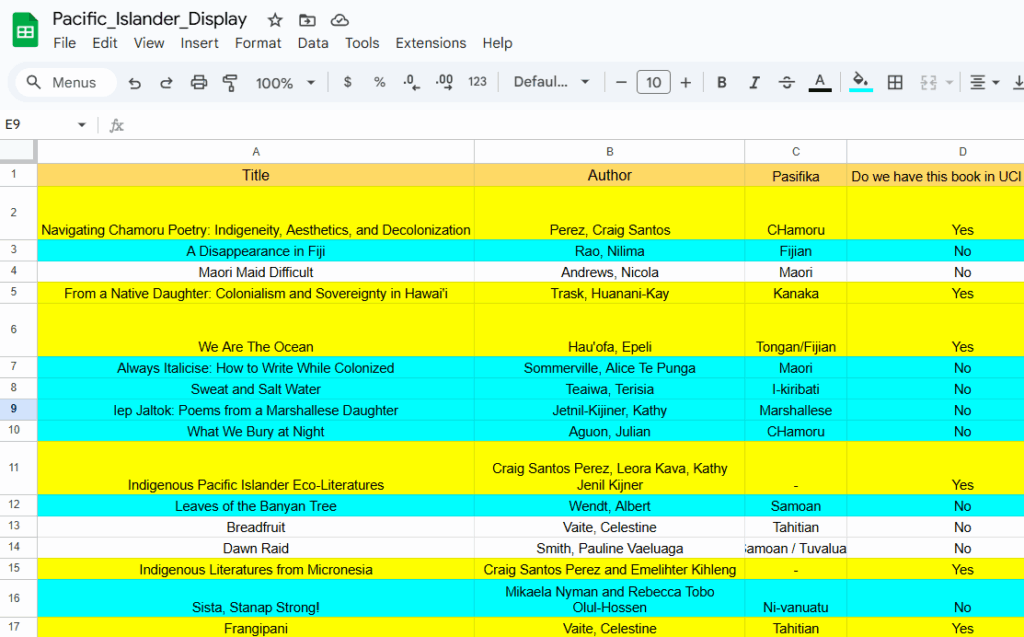
The shared excel sheet used for the purchasing process of this display.
Our biggest takeaway from this project is that the school community is more than willing (and excited) to contribute to library spaces. By having students, staff, and faculty contribute to our collection, we are able to build rapport with our patrons and better reflect their experiences. UCI is a federally designated Asian American and Native American Pacific Islander-Serving Institution (AANAPISI), but many could argue that there has been little-to-no representation of its Indigenous student body. As library professionals, we believe that it is crucial for us to uplift diversity, rather than be complicit in erasure. We hope that this project, along with the APALA Literature Awards criteria changes, sheds light on Pacific Island voices and experiences.
Key Terms for Building/Starting a Collection of Pacific Islander Works
AAPI = Asian Americans AND Pacific Islanders
Pacific Islander = the race of indigenous peoples from Pacific Island nations
*We want to acknowledge that while Pacific Islanders are Indigenous peoples, and there are several Pacific Island nations that are a part of the U.S. empire—either as a state (Hawai’i), unincorporated territories (Guam, American Samoa), or freely associated states of the United States (the Marshall Islands, Palau, and the Federated States of Micronesia)—Pacific Islanders are not Natives of the North American continent, who face their own unique experiences and struggles in the United States and Canada.
Pasifika = a synonym for Pacific Islander (used more commonly in Australia and New Zealand)
NHPI = Native Hawaiian and Pacific Islanders (both are Pacific Islanders; Native Hawaiians are separated because Hawai’i is the only Pacific Island nation that is a state)
Oceania = the continent of the Pacific Island nations