by Kannan Cangro
Stepping into the America’s Center in St. Louis for the 2025 American Association of School Librarians (AASL) National Conference felt like walking into the pulse of school librarianship. As a K-6 school librarian, this event was more than just professional development; it was a deeply revitalizing community gathering. The energy was palpable, from the opening keynote’s fierce blend of advocacy and passion to the rich tapestry of concurrent sessions.
One of the most rewarding aspects of the conference was the opportunity to share my work. My concurrent session, “Sparking Innovation: Integrating STEAM and Computer Science into Your Library Program on any budget,” drew in a group of librarians eager to transform their libraries into hubs of hands-on, creative learning.
My presentation offered a practical guide to seamlessly integrating STEAM (Science, Technology, Engineering, Art, and Math) and Computer Science into the school library, regardless of budget constraints or prior experience. I structured the session around my personal evolution:
First, I shared how my foundation in art (I am a former elementary art educator) and repurposed materials led me to embrace hands-on learning. We explored how to start small using readily available, low-cost resources like Brainflakes, straws, KEVA planks, and pipe cleaners to introduce maker-centered learning and the Engineering Design Process.
Then, I discussed how a multi-school wide initiative, fueled by a Boeing grant, propelled my library into a comprehensive hub of STEAM and computer science exploration. After these beginnings, our PTA generously funded the introduction of more specialized tools, like BirdBrain Finches and Terrapin Blue Bots. This has elevated our programming from basic centers to in-depth, curriculum-aligned lessons.
Finally, the core of the session focused on tangible strategies for implementation, emphasizing how making literacy connections amplifies the impact of STEAM challenges. We looked at examples of transitioning from basic center activities to integrated lessons that foster critical thinking and problem-solving across various grade levels.
During the discussion portion, attendees exchanged ideas on how they use STEAM and Computer Science and how to fund their own resources. It reaffirmed my core belief that the school library is the perfect place to nurture creative problem-solving.
The spirit of collaboration at AASL extended beyond my scheduled session. I was honored to step in last-minute for author Deborah Rinio to join Maura Madigan, a colleague from my school district, on the Page to Practice Stage for their interactive interview, “Beyond Books: Real Talk on Active Learning in Elementary Spaces.” With Maura, we engaged the audience in a dynamic discussion drawn from her and Deborah’s books in the AASL Standards-Based Learning Series. We shared practical strategies for leveraging learning centers, project-based learning, and short, impactful STEAM activities to foster curiosity and collaboration in the elementary library. It was a perfect, extemporaneous extension of my own work, demonstrating the conference’s culture of sharing and professional support.
As a school librarian, I often find myself in a solo role within my building. The true heart of the AASL National Conference is the unparalleled community. St. Louis, the “Gateway City,” truly felt like a gateway to a shared professional home.
Connecting with colleagues from all corners of the country sharing a chat in the exhibit hall, commiserating about challenging policies, and brainstorming new initiatives provided a vital sense of solidarity. These informal networks are just as important as the formal sessions. I especially enjoyed meeting up with fellow members of the Virginia Association of School Librarians (VAASL) and exchanging notes on everyone’s take-aways. I had my own personal fangirl moment when I met Mitali Ruths, Southeast Asian author of “The Party Diaries” series, in the exhibit hall. I shared with her how much I had wished her books existed during my own childhood reading days because it was not until adulthood that I saw myself in a book. However, I was so grateful her books exist for my own Southeast Asian daughter.
The conference celebration, “Meet Me In St. Louis,” was a joyful culmination of three days of intense learning, providing a much-needed moment of collective celebration and fun before returning to our schools.
Leaving St. Louis, I feel energized, affirmed, and armed with both practical strategies and a renewed passion for the role of the school library. The 2025 AASL National Conference was a powerful reminder that librarians are part of a national collective dedicated to transforming learning. Our work is essential, and the librarian community is our strength.
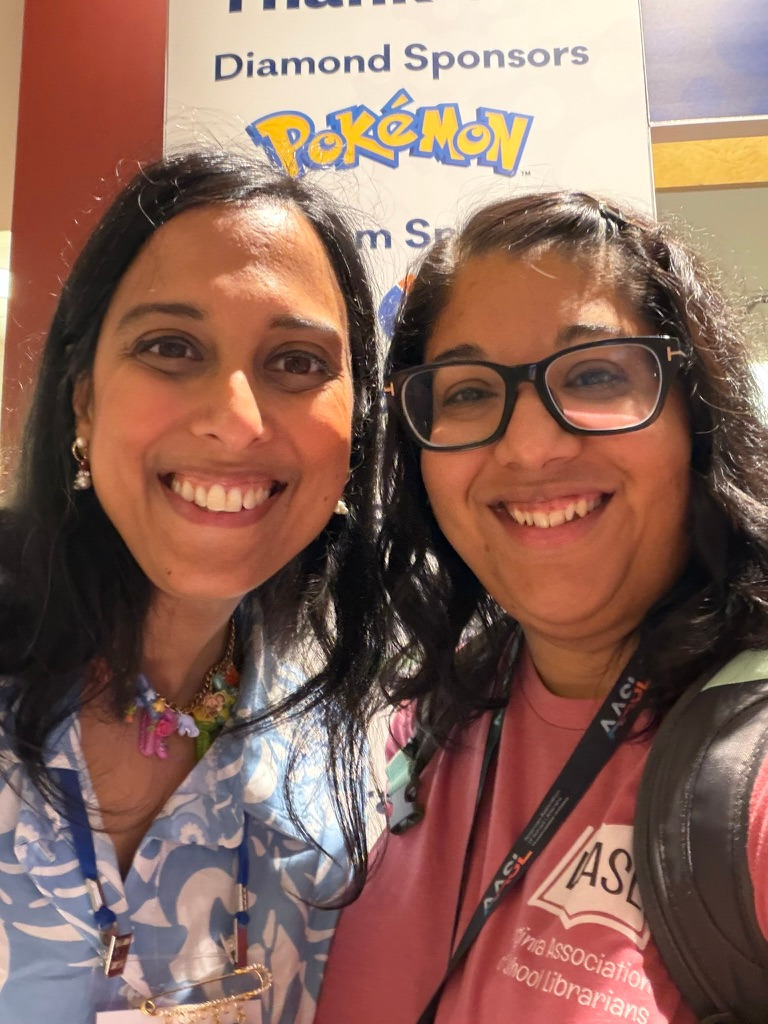
Kannan Cangro with author Mitali Ruths
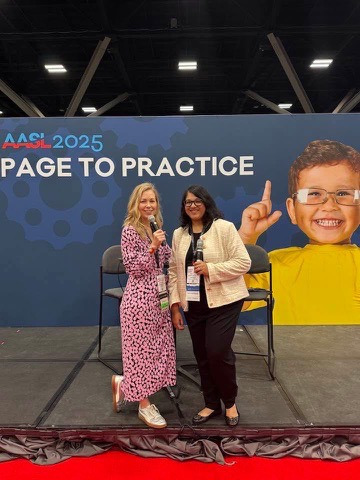
Kannan Cangro with fellow librarian Maura Madigan