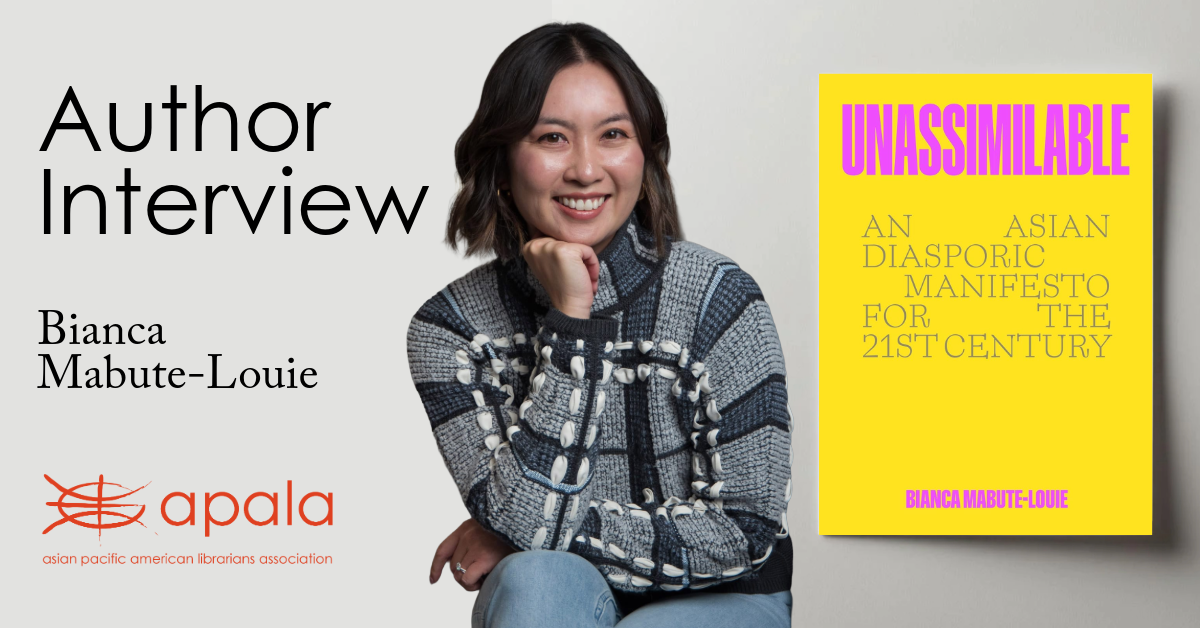
Unassimilable: An Asian Diasporic Manifesto for the Twenty-First Century is a scholar and activist’s brilliant socio-political examination of Asians Americans who refuse to assimilate and instead build their own belonging on their own terms outside of mainstream American institutions, transforming the ways we understand race, class, and citizenship in America. Unassimilable is Mabute-Louie’s first book, published by Harper in January 2025.
APALA member Joshlyn Thomas sat down with Mabute-Louie this summer over Zoom for an interview about the book, libraries, experiences around the Asian diaspora, and a shared love of zines. Joshlyn is an emergent librarian based in Houston, TX. She is the daughter of Mayali Indian immigrants and is interested in stories about the broader Asian and Pacific diasporas. She has been a member of APALA since starting library school in 2020. More recently, she was a protégé under the guidance of Miriam Tuliao during the 2024 – 2025 APALA Mentorship Program. Currently, she is a member of the 2025 – 2026 Program Planning Committee. She is a firm believer in the power of public libraries, public radio, and physical media. In her free time, she enjoys discovering new music and expressing creativity by screen printing, zine making, and ceramics.
Enjoy the transcript from their conversation.
Joshlyn Thomas (JT): Please introduce yourself and briefly describe your literary work and career path to date.
Bianca Mabute-Louie (BML): I’m Bianca Mabute-Louie (she/her). I recently published my first book, Unassimilable: An Asian Diasporic Manifesto for the 21st Century. But my career path has been more in the classroom, so it’s exciting to talk to a librarian creating access for students and in the community to be able to read more. That’s really what I think grounds why I do what I do and even the kind of book that I wrote.
I’m in academia right now. I’m finishing my PhD, so my career path has been a pretty traditional route, I would say. I’m doing all the things to try to get a tenure-track position, but the book was really– from the perspective of other people on the outside– felt like a left turn. For people who know me, I don’t think they were surprised because, even though I have been pursuing this academic route, I have always been committed to and grounded in teaching and being with my community and creating work that is accessible to my community and in conversation with my community, and that’s very much what this book is about. It has a little bit to do with my PhD work, but it’s more of a memoir/autoethnography/sociological argument on Asians in the U.S. Diaspora.
JT: How does your personal identity influence your writing and/or the diversity of your readership?
BML: I guess should have said this in the question before but when I said I was in the classroom, I specifically taught Asian American Studies [at] the high school level and community colleges and state colleges in the San Francisco Bay Area. I wanted to write a book that I could use in my class– except now that I do have it, it’s so awkward to assign your own readings. I would never actually use my book, you know, but it is a book that my teaching colleagues could use in the ethnic studies classroom.
For me, my intention was actually very much the opposite. I’m gonna really contend with my ethnic and racial identity and the contradictions that I’ve experienced, the ways that I have felt like it’s been limiting and confounding and especially in relation to racial dynamics in the U.S. more broadly, what it means to be a non-Black group of color that benefits from white supremacy and is also victimized by white supremacy. I wanted to dig deep into what that meant for me and people around me.
But the book is for everyone. I think one thing about writing is that the more specific it is, actually the more universal it is. I was encouraged by my agent to really go into the specificity of growing up in an ethnoburb and the specificity of being a queer, Chinese, former Baptist and the specificity of evangelical campus ministry. I found that really specific stories resonated with so many non-Asian audiences.
For example, in my book tour, I remember at most of my events, most attendees are Asian women. But at my LA book tour event, there was an older white man in his… I would say 70s or 80s… He stood in line for the signing and to talk to me. He was like, “I came because of your chapter on being queer on an evangelical campus.” That’s a very specific experience, but he was like, “I related so much to every word of that chapter.” I think he even said he was part of that same campus ministry but like 30 or 40 years before me, so it was kind of cool.
I got responses like that from people who were mult-racial and other people of color who weren’t Asian. I thought it would mostly be people my age or younger who read it, but I have a lot of parents coming to my book events saying, “My gen-Z kid in college forced me to come to this and now I’m gonna read this with them” or “I actually read this with my kid and I actually really like it. It’s taught me a lot about their experience.”
The readership is actually a lot more diverse than I expected because I was very much going into this like, I’m not writing for white people. I’m trying the best I can to not write for this white-dominated industry. I’m kind of unapologetically writing for people like me. I think the impact has been more expansive than that, which is great.
JT: That was such a delicious, juicy answer! As an aside, I totally relate to the specificity of the ethnoreligious experience that you shared in your book and also as a queer person. It was super relatable and validating in ways that I thought I would never read in print. APALA is always looking for more to read. Who are some authors we should be reading? Why?
BML: Right now I’m reading Hala Alyan’s memoir, I’ll Tell You When I’m Home. She’s a Palestinian-American poet and novelist. She’s very popular already but I love R.F. Kuang. All her books blow up and I loved Yellowface but Babel really has a place in my heart! Even just thinking, you know, as someone who, after October 7, 2023, really grappled with texts like Wretched of the Earth by Franz Fanon and these revolutionary, post-colonial texts… I was reading Babel at the same time. Babel actually touches on a lot of those same things I was reading [in Wretched of the Earth] but in the fantasy genre, which is so fun.
I’m trying to re-read Assata Shakur’s autobiography. I read it for the first time ten years ago but now I’m such a different person. These are not new books, but they’re new to me. There’s a book that’s been on my list… I’ve been listening to podcast about it, but it’s called The Jakarta Method. Again, in the light of the past two years, a lot of what I’ve been reading has either been [an effort to] try to unlearn the propaganda I’ve internalized about the American empire, so The Jakarta Method is part of that. It’s about the CIA’s genocide of 2 million communists in Indonesia and set the ground work for the rest of the Cold War. But I also read escapist fiction. I love Danzy Senna. Am I supposed to be naming Asian American writers?
JT: No, it can be anybody!
BML: Okay, these are just things I happen to have read in the past year. Oh actually, this writer is half-Vietnamese, I think. It’s called Words for My Comrades: A Political History of Tupac Shakur. I’ve been listening to the audiobook and it’s pretty long. I thought I knew about the Black Panthers but I’ve been learning so much more! It mixes so many different genres. It’s not exactly escapism but it’s been a revelatory history of not just Tupac Shakur but the context in which he became politicized and became an artist. Those are some things that have been on my bookshelf.
JT: I’ll have to check them out! These are all going in my TBR for sure. You’re being interviewed by a librarian, for an audience of progressive Asian Pacific Islander Desi American librarians. What are your thoughts on libraries, and their place in building diverse communities?
BML: Oh my gosh! I mean, I’m preaching to the choir about this, but libraries are my favorite underfunded third space! Especially since having a kid, I don’t know what I would do without our multiple libraries that we go to. I mean, we’re both in Houston, TX where there is a grave assault on critical thinking and books and libraries. I heard with the HISD [Houston Independent School District] takeover, one consequence is that school libraries are getting shut down and I think it’s devastating.
Libraries are so much more than just books, they’re the social safety net. They’re sometimes peoples’ homes during the day. It’s where people go to charge their phones and have AC, which is a necessity here in Houston but not everyone has access.
I feel this way about public transit too. When I was in the Bay Area, I felt like BART was a kind of receptacle for a lot of our social inequality, and I feel that way about libraries too. Again, there are so many social issues or inequalities, things like access to housing or jobs, that the library ends up being a container for just because it is an open, public third place for people. It’s about reading and books, obviously, and that has a lot of connotations. But it’s also the health of our society.
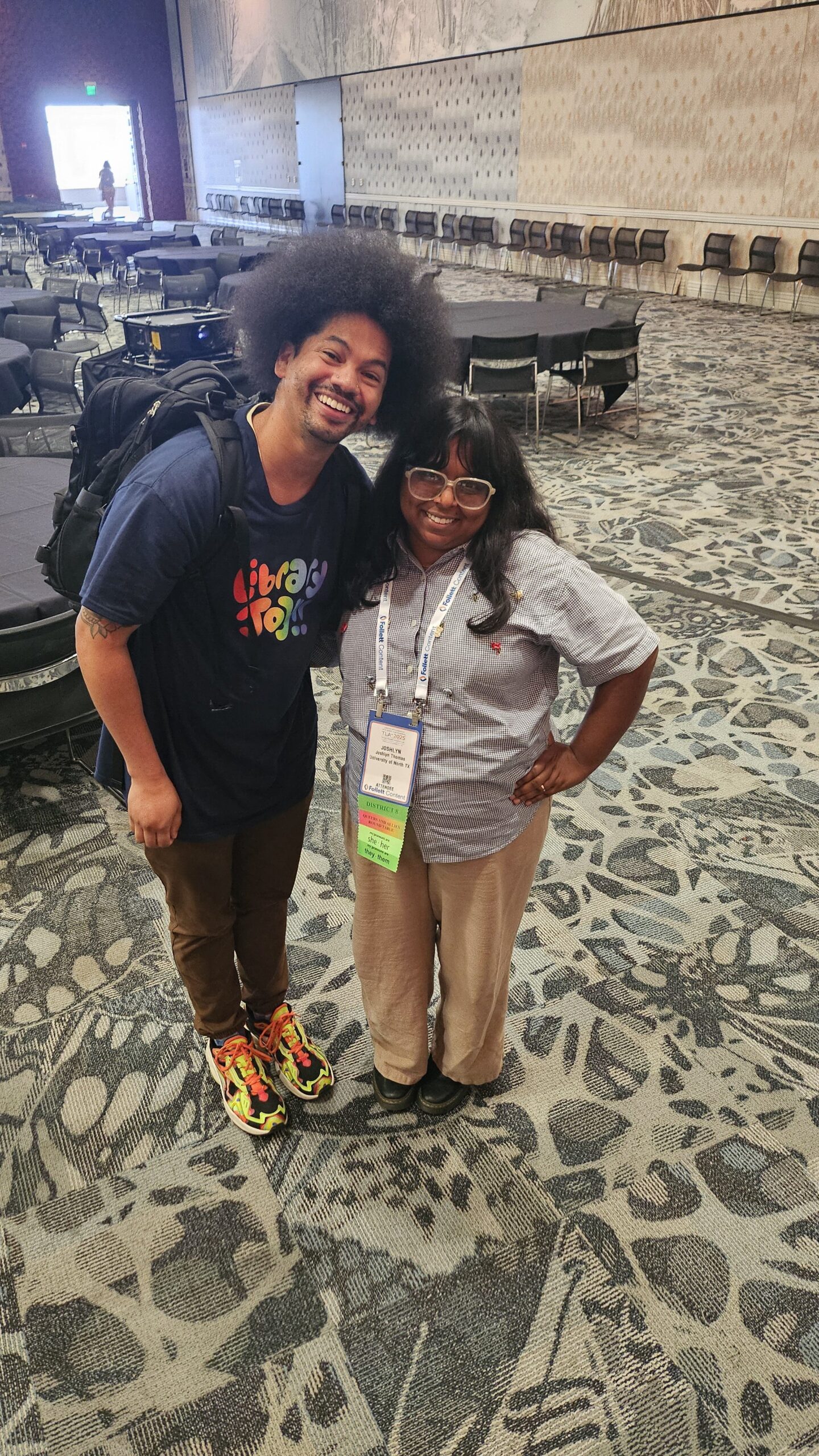
JT: Thank you so much for sharing that because that is so validating to hear, especially as an early career librarian. I’m so scared of what the future of libraries and the world in general are going to look like. It’s so affirming and validating to hear you talk about libraries as third spaces and what they have to offer in not just our community but our society.
BML: Yeah, and I think even the childcare crises we have, libraries fill that void too. There’s programming– and obviously you know this better than I do– so much programming that the library puts on, literally Saturday afternoons when– I don’t know… I have a two year old who is bouncing off the walls and it’s the library that’s our container, our family’s container, where he can let his energy out and we can meet other families. I wish that it was more funded so that it could be open on Sundays and our librarians could be getting paid more and there could be even more.
JT: It makes me so happy to hear that our library systems here [Harris County Public Library and Houston Public Library] in Houston have been a resource for you as a new parent.
BML: Oh my gosh, yeah! I would lose it without our library, probably!
JT: As a fellow zinester, I have to ask: How did your knack for zine-making influence the overall writing process for Unassimilable? I love the illustrations you included in the book!
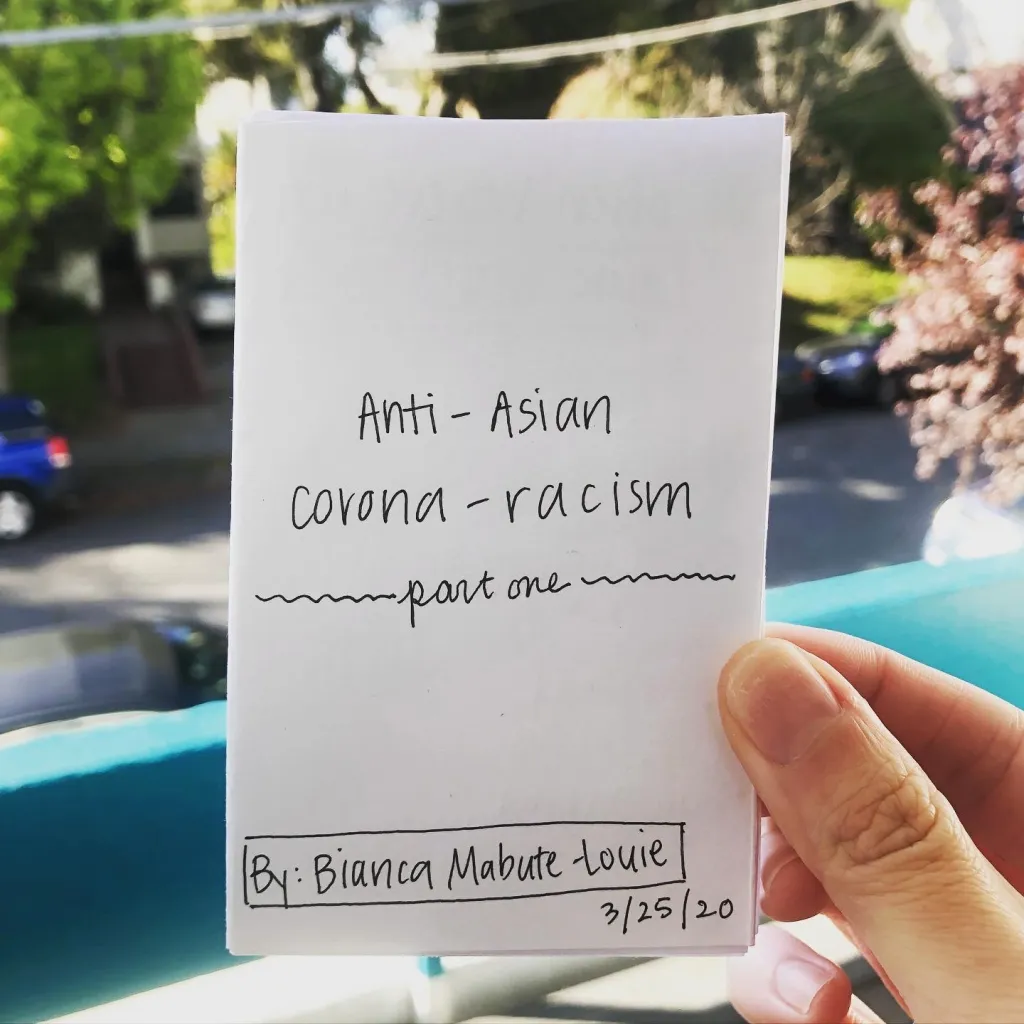
BML: I feel like there are other people who are way more well-versed or creative at making zines than me, honestly. But I would use [zines] as a teacher in my classroom as a creative outlet for my students to process or share about different things that we were learning about. Actually, in the pandemic, I started making zines about how to think about anti-Asian racism, Black Lives Matter, and different social issues because that’s what I would have been doing in my classroom anyway.
Going back to the career question, I was always a very private writer. I wrote some op-eds here and there with some very small outlets, but I didn’t even have a public social media page. It was during lockdown when I started making and taking pictures of zines mostly political education zines. I think that’s how my audience grew in the beginning. When I was pitching my book, the editor who picked it up and my agent were both very aware that was how my audience came to know me, so they pitched the idea to me, “What if we integrated these zines and these political education cartoons into the book?” I was very reluctant at first because I felt like it took away from the kind of serious book I wanted to write and very much wanting to brand myself as a public scholar, all this stuff. But then at the same time, who even defines what is intellectual, right? Again, going back, I wrote this book for my community and I think visuals do activate the brain in a different way. Short stories in an eight, nine, or however many panel slide deck is a different kind of storytelling that can hopefully reach more kinds of people.
I went back and forth a lot internally because, again, I didn’t want to break the typical form of a book. But then again, who decides those things? We can do whatever we want!
JT: I really loved how each chapter ended with an illustration, especially the ancestor altars. It was such a beautiful tribute to all the different AAPI activists who were invoking. Today at work I shared some of this book and the illustrations with my boss, telling him I was so nervous for this interview! But I’m so excited and I feel like everyone should read this book.
It’s so interesting to hear that your publisher encouraged you to share your illustration and it’s such a cool way to disrupt the conventions of what a “serious” book is supposed to be and how it’s supposed to be structured.
BML: Thank you! Thanks for saying that because I didn’t know how it was going to be received. If people don’t like it, they don’t tell me to my face. I’m glad it resonates with you.
JT: Yeah! It’s so cool! I was totally making zines out of one page of paper writing down all my thoughts during lockdown too. I needed to do something that was not on a screen and I needed somewhere for all these horrible, scary thoughts to go.
JT: What advice would you give young professionals, especially those from diverse backgrounds, who are interested in a career in writing?‘
BML: That’s a good question. I would say do it in community. Writing is a very solitary act and practice. It can be hard to hold yourself accountable and it can be very isolating. I have found that to be the case in the past while writing this book and the current projects I’m working on. I think writing groups have been helpful, just connecting with other authors and other people who have similar goals and understand the struggle of not knowing anyone in publishing or know anyone who has written a book, you know? If you’re not in that world, it’s helpful to figure out how to navigate it with other people. I say that also because when the book came out, it was with Harper Collins which is a big publisher and they have a lot of resources for marketing. But sometimes they don’t know how to market your book, especially if it’s for a more niche audience. So I really relied on my community to help me market the book.
A lot of reviews people had written were members from my writing community. People would say, “Okay I’ll read it, I’ll write [the review], and I’ll pitch it to KQED” – for an example, because I know someone there. It was really our organic network that gave it the visibility it did, including book events too. I don’t want to just do bookstores because I feel like my readers are not only in bookstores but also in community spaces because they’re organizers and students, so I did a lot of school events with my friends in academia and ethnic studies who said, “I’ll have my department come sponsor you.” At every event, I felt like I was coming home in some way because it was my writing and education community that supported me and made it happen. It made the experience so much richer. I never really felt nervous before any event because this is my community.
JT: I love how you invoke the image coming home in doing this work. As a reader, I felt like I was coming home, into a home where I was fully accepted for all these different identities that we share.
BML: Aw, thank you for saying that!
JT: I do have one last question. What advice do you have for library workers who want to advocate for a ceasefire in Palestine but are not sure where to start?
BML: I recently listened to a podcast episode featuring Writers Against the War in Gaza. They were talking about a cultural front, and the word “front” really stuck out to me because that’s a military strategy word. But culture is its own front which includes, I feel, libraries and books as sites of community and cultural production. There’s this saying: We’re not all going to be on the literal battlefield, or be in policy, or on the ground, or doing direct action– but because Zionism has co-opted so many cultural production spaces, we have to engage in culture as a front. We’re coming at it on the offense. We’re creating things to put forward the humanization and liberation of Palestinians. It actually is a site where we wage struggle.
Going back to the question, wherever we are, we have the responsibility to push that, to try to front from where we are as much as we can. I struggle with this because I feel like with the book tour and this book, I did try to do that. Sometimes I feel like I’m not doing enough. I have a hard time with academia because academia is obviously a huge front where I could engage more and it’s a hard place really for me to be in too, and it’s where I get my health insurance. There’s so much tied there. I think we all have to make negotiations and calculations about what kinds of risks we’re going to take and how we’re going to put ourselves out there, how to be strategic.
In terms of library workers, think about whatever institutions you engage with as a front too. It maybe doesn’t have to be defensive but maybe there’s room for imagination and creativity in the kind of programming you all do, or the displays that you put up, or the publishers or institutions you might come across. There is, I think, opportunity for all of us to practice BDS [boycotts, divestments, or sanctions] or the spirit of BDS in some way. These are just some ideas off the top of my head, but really engaging the sites where we have influence. Again, I feel like it’s hard to make an impact anywhere unless we are doing it in community and coalition with other people, so it’s awesome that APALA put out a statement together. I don’t know if there’s a working group or something, but things like that are important to think about, strategy-wise because individual acts are cool but no individual is going to solve this. It really is collective action, being in coalition in with one another, being coordinated with each other and what we do can make an impact.
I think statements like these really matter too and there are so many institutions afraid to make very simple statements, you know? Things like this matter. I also think about… Speaking of BDS, I’m part of the Association of Asian American Studies and they were the first actually to adopt BDS and disaffiliate from Israeli universities, something that most universities in America haven’t even come close to doing. Thinking about how we’re all in institutions that are all connected to these different webs, often these webs benefit from militarism and profiteer off of weapons, the call from BDS is to isolate these webs. There are ways that we can push for our institutions to cut off ties.
JT: Thanks you for offering so many actionable ways to do that and for acknowledging that it’s a constant negotiation and it’s also work that has to be done collectively.
BML: Thank you for reaching out! If there’s anything I can do to support you or APALA, let me know. I really mean it when I say that libraries are my favorite underfunded resource!
The interview was conducted by Joshlyn Thomas in July 2025 over Zoom, with editing assistance by Emily Espanol