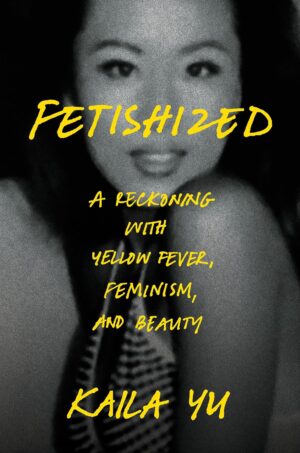
Fetishized: A Reckoning with Yellow Fever, Feminism, and Beauty
Written by Kaila Yu
Publication date: August 19, 2026
256 pages
ISBN: 978-0593728017
There are scant few Asian American actresses who could speak about the experience of being exoticized in Hollywood. Of all of them— from Michelle Yeoh and Lucy Liu to Constance Wu, among others— Kaila Yu emerges as the perfect documentarian for an Asian American woman’s experience in the spotlight during the aughts and tens.
A Playboy pinup, an actress with a blink-and-miss-it cameo in The Fast and the Furious: Tokyo Drift, a lead singer in an all-girl rock band, and now an influencer with a social education angle, Yu flaunts her long resume and reflects on her career in her debut memoir Fetishized with clear eyes after years of therapy and hard-earned self-knowledge. In each chapter, she connects her personal journey to the larger story of how Asian-American women are viewed in society and how these women are taught to view themselves in turn.
For every action she takes, Yu vulnerably admits to being motivated by internalized misogyny and colonization that many other Asian-American women might not recognize in themselves. She details her desire to be looked at in a way that confers some sense of value, be it commercial, romantic, or sexual. Therein lies danger. As Margaret Atwood wrote, in every woman is a man watching a woman. In this case— in many cases, regardless of a woman’s race— that man is white, heterosexual, and hegemonic in every other way. To Yu, uncovering him, de-identifying from him, studying him, and learning to accept him brings liberation.
Understanding the other that lives within proves near impossible because of inherent double standards, which is why many women will reject going as far as Yu has by publishing personal stories on the subject. Many readers will scoff (and have scoffed, since the book’s fall 2025 release) at Yu’s story, as she admits that what brought her to sketchy, objectifying shoots, to plastic surgeries for her eyes and breasts, and to female rivalry instead of sisterhood was to consciously chase male attention. How dare she ask for pity, reviewers say, when she asked for it all along.
These readers will also know “kawaii” translates to cute. Lesser known translations that Yu cites bring us to “pitiable or poor,” “something one should feel love for,” and “something small or petty.” Throughout the memoir, Yu does not perform “kawaii.” She does not want us to pity her. The more sympathetic reader— who is unfortunately not the audience this message needs to reach— will know Yu unveils her colonized psychology and her misogynistic motivations to question who put them there.
Towards the end of the book, as the power struggle escalates from Yu’s petty exes to her broadcasted sexual assault, to her own grooming of her younger bandmates, and finally to her experience of the post-COVID violence against AAPI communities, Yu looks into camera once to address her true audience: the archetypal, overpowered White Man, the colonizer who will read her stories and feel upset when he perceives a woman who openly admits to chasing his attention asks for his pity. She addresses the colonizer who lives in us all when she writes “We saw it [violence] coming with your Asian fetish” (p. 218).
While this book is not for our community (for what community does not understand its own struggle for humanization?), it brings much-needed context for readers who are maturing politically into a world fighting itself or wanting a first-hand perspective on fame and show business during the last three decades of societal transitions. But especially, this is for our sisters who commit acts of self-harm when they senselessly chase external validation.
This book is also for lovers of Not Your China Doll: The Wild and Shimmering Life of Anna May Wong by Katie Gee Salisbury and Love, Queenie: Merle Oberon, Hollywood’s First South Asian Star by Mayukh Sen. For further exploration of the celebrity culture around women, try Girl on Girl: How Pop Culture Turned a Generation of Women Against Themselves by Sophie Gilbert.
Review by Emily Espanol with editing from Matthew Galloway.
Book reviews and author interviews featured on APALAweb.org are reflective of the reviewer and interviewer only and are conducted separately from and independently of APALA and the APALA Literature Awards Committee and juries.