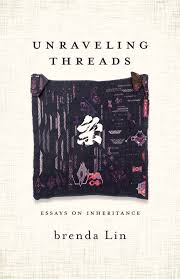
Unraveling Threads: Essays on Inheritance
Written by brenda Lin
Publication Date: August 2026
216 pages
ISBN: 978-0-8142-5988-7
Reading brenda Lin’s Unraveling Threads: Essays on Inheritance is like savoring a piece of candy thoughtfully. As I moved from page to page marveling at the images of butterfly and spider motifs embroidered onto traditional Miao clothing, I thought about my own family’s collection of stories, beliefs and inside jokes that strengthen our connections to one another. How do I experience my ancestors through the stories retold and photographs shown to me by my grandmother and mother?
Unraveling Threads reminded me of my own beloved curation of favorite writings: singer-songwriter Michelle Zauner’s Crying in H Mart, the prose poetry-memoir hybrid works of Maggie Nelson, Dorothea Lasky, and Patti Smith. Additionally, Mitski’s lyrics on organization, beauty and cleanliness come to mind while reading Lin’s work. Composed of thirteen vignettes brenda Lin leads us through reflections of her upbringing in Taiwan, Singapore and the U.S. This book speaks to a variety of readers: code-switchers, those raised in multicultural households, young parents, and textile aficionados.
Lin’s writing style is filled with visceral metaphors interspersed with Chinese character translations. For those not acquainted with the language, these definitions allude to Lin’s familial dynamics and ties to home, identity and traditions through textile construction associations. One passage I adore is Lin’s description of her desire to tap into the writing flow which appears as “scraps, like candy wrappers I would pocket and immediately forget about.” Instantly, I recalled Patti Smith’s Year of the Monkey where she recounts a precognitive dream of thousands of candy wrappers strewn on a beach like fallen confetti. Smith’s wrappers are a surreal wink that provokes readers to determine between the real and unconscious landscape. Lin’s hopefulness to reunite with a writing ritual takes its form in something sweet that might reveal itself later as successful. I’m pleased to read about these two interpretations of candy wrappers that are like a talisman which signals transformation for its beholder.
Lin provides insight to the artisans’ diligence and the attention to detail required in the Miao tradition of “women’s work” which includes garment making, caretaking, childrearing, storytelling and recordkeeping. Part memoir and part anthropological study, Lin’s prose also highlights the ever-evolving relationship between her grandmother, mother and herself. Her feelings are explored through textile terminology i.e., the tightness and looseness of a weave and the adornment of fabric on the body. As both a daughter and a mother, Lin points out the “knots” in her relationship with her mother and with her children; these points of tension and relief echo that of the tight and loose weaves of a knit.
I could not help but reflect on my own relationship with my matriarchal line, in particular my mother and grandmother. Where Lin’s family connects in a “braided language” of English, Mandarin, Taiwanese, Japanese, and Cantonese that’s exchanged between family members of different generations, I was raised in a household that conversed in English, sang in Dominican Spanish and scolded in Japanese. Language, as brenda reflects, is a form of inheritance. It is intrinsically tied with her own memory and the stories of her ancestors. Echoing her mother’s textile collection of children’s shoes and baby-carriers from the indigenous communities of China and Taiwan, Lin’s book itself is organized into an assortment of tensions, folds, and braids where language, memory, and time intertwine with one another to form a meaningful quilt of her life, and of the lives that extend from it. Time spent together is expressed in these objects of affection. For less than two hundred pages, I move alongside brenda as she points out to me her most cherished memories that continue to linger well beyond when I’ve concluded reading. Unraveling Threads: Essays on Inheritance offers me a quiet place to reflect upon the sacrifices and gifts parents and children exchange between one another in all stages of their lives.
Review by Katie Iwagami with editing assistance by Emily Espanol.
Book reviews and author interviews featured on APALAweb.org are reflective of the reviewer and interviewer only and are conducted separately from and independently of APALA and the APALA Literature Awards Committee and juries.
To submit a book review, contact the Media & Publicity Committee at communications@apalaweb.org.