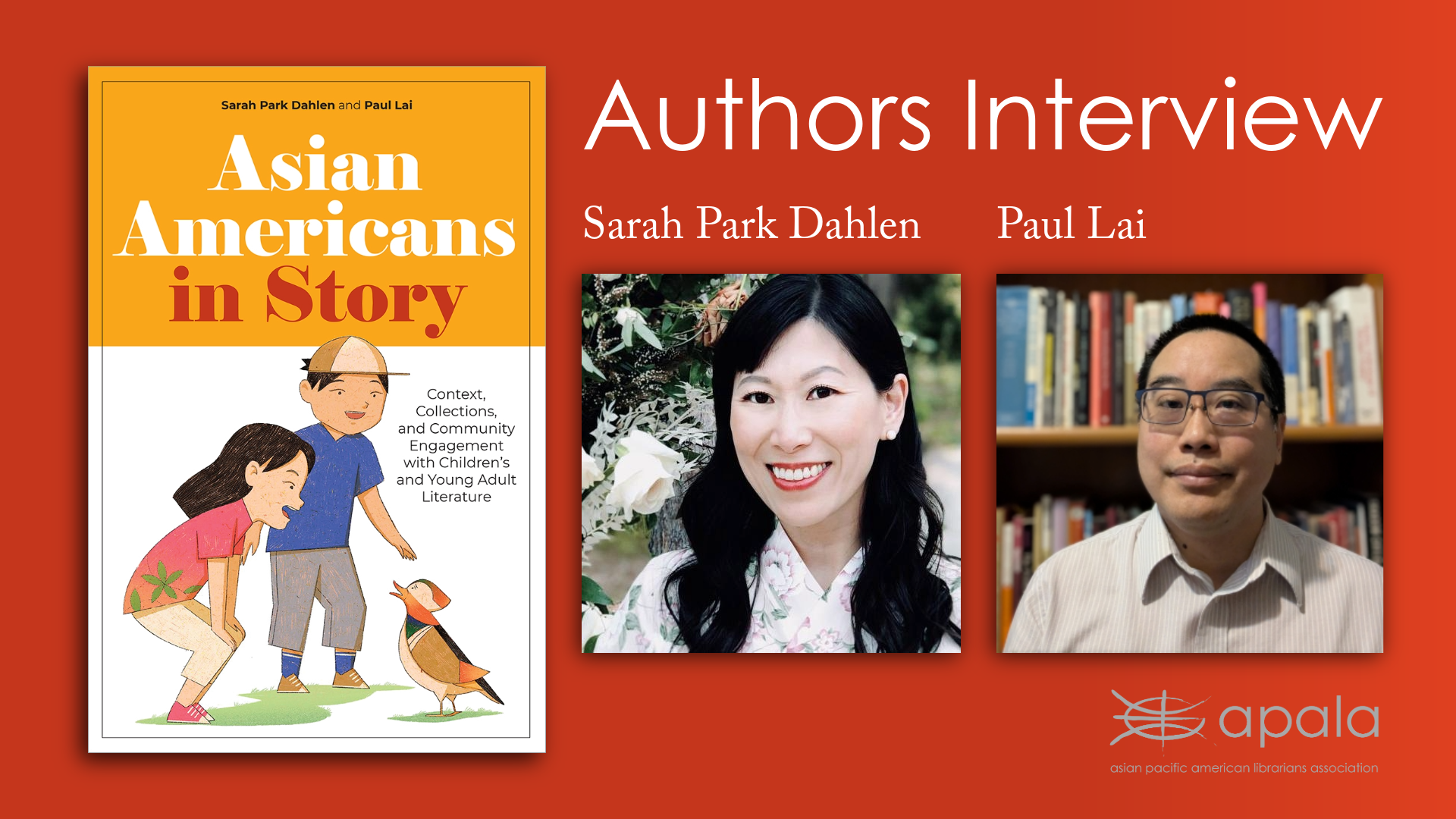
Asian Americans in Story: Context, Collections, and Community Engagement with Children’s and Young Adult Literature analyzes one of the most vibrant yet underexamined bodies of works in the larger body of literature —Asian American children’s and young adult literature. In this new book from ALA Editions, the authors delve into the context and content of Asian American stories for youth by tracing the development of Asian American youth literature and the ways in which these titles continue to diversify, drawing on AsianCrit and the APALA Evaluation Rubric to critically analyze the complex issues surrounding the representations of Asian Americans in youth literature, and exploring key themes in Asian American lit.
APALA is excited to present a Q&A with members Sarah Park Dahlen and Paul Lai, ahead of their late 2026 publication.
APALA: Please introduce yourself and briefly describe your academic work and career paths to date.
Paul Lai (PL): My name is Paul Lai, and I began my career teaching and researching Asian American literature. I transitioned to library work over a decade ago but continued focusing on Asian American literature in my reading and thinking. I’ve worked in public and academic libraries, primarily in public services and student success. This work included designing programs such as book clubs, author events, film screenings, civic engagement discussions, and more. Meeting Sarah early in my career also helped me look consistently at children’s literature as a legitimate scholarly focus about the impact of popular reading.
Sarah Park Daheln (SPD): My name is 박사라 Sarah Park Dahlen and I’m an associate professor at the iSchool at Illinois. I also have a background in Asian American Studies from UCLA, where I began studying Asian American youth literature. I earned my PhD and MS in Library and Information Science from Illinois, moved to Minnesota for my first job, and then returned to Illinois in 2021. I’ve been very fortunate to teach an Asian American youth literature course here!
APALA: Do you think your personal identity influences your research interests and/or the diversity of your readership? How?
PL: Absolutely! Reading Asian American literature has always been a way for me as a 1-½ generation Taiwanese American who grew up in California and lived in a few other regions of the United States to connect my personal history to the multilayered histories of different ethnic groups, both Asian and otherwise. Feeling often like the only Asian American in public, school, and work spaces led me to seek stories of people like me. I am also very interested in refusing the dangers of the “single story,” and reading is one of the best ways to develop a wide sense of perspectives, histories, and identities.
SPD: Yes, for sure! I identify as a 2.5 generation Korean American, and I grew up in a suburb of Los Angeles, where I lived among a large Korean American community and even had teachers who were Korean American. Despite that, I never saw a reflection of myself as a Korean American girl in children’s books, yet I always had a strong sense of being Korean.
APALA: What compels you to research Asian Americans in children’s and YA literature?
PL: There is so much wonderful youth literature by Asian American authors and illustrators that often goes unread while racist stories continue to be shared. Our research champions Asian American stories for all readers and especially young Asian American readers for whom seeing non-stereotypical versions of Asians in published books is crucial to a strong sense of identity.
SPD: Despite having more Asian American youth literature, we also see more anti-Asian racism within some books, such as slanted eyes, that need to be broken down and communicated to readers, educators, and publishers so we understand their white supremacist origins, recognize them, and learn to critically evaluate them. Also, there has historically been a dearth of research on Asian American youth literature, so there is much work to be done on the many books available for young people. To be clear, while we celebrate most of these books, our intention is not to be promotional, but evaluative.
APALA: From your research, what might surprise a lay audience, especially the educators and parents nurturing their young people’s reading habits?
PL and SPD: They might be surprised at how frequently damaging stereotypes of Asian Americans appear in children’s literature such as depictions of slanted eyes and gibberish language. Learning the histories of Asian Americans can help educators and parents recognize these stereotypes and explain to children what they are seeing. Educators and parents might also be shocked to revisit their own childhood encounters with Asian racialization in children’s literature to realize how problematic some popular books are.
APALA: What effect do you hope this research will have in libraries and schools
PL and SPD: We are excited to encourage more people to read widely in the burgeoning books by Asian American authors, and we hope this research will help guide book creation, collection development, personal purchases, curricular development, and other engagements with the literature.
APALA: We’re always looking for more to read. Who are five authors we should be reading? Why
PL and SPD: This question breaks our brains because Asian America is so diverse. But we get 10 selections because there are two of us, right?
Lisa Yee—Chinese American author of multiple award-winning books and series, Yee offers a great starting place for young readers of fun stories featuring Asian American protagonists.
Ellen Oh—Korean American author of middle-grade and YA novels, Oh is also a founding member of We Need Diverse Books and a fierce advocate for diversity in children’s books publishing.
Sun Yung Shin—Korean adoptee author Shin’s writing for young readers includes a picture book about a biracial Korean American boy, a biography of revolutionaries James Boggs and Grace Lee Boggs (co-authored with Mélina Mangal), and the forthcoming young readers’ edition of Catherine Ceniza Choy’s Asian Asian American Histories of the United States (co-authored with Sarah Park Dahlen).
Mike Curato—Filipino American author-illustrator Mike Curato’s delightful picture books are a powerful contrast to his YA graphic novel Flamer that handles a tougher topic of coming to terms with gay sexuality.
Gene Luen Yang—Read beyond his deservedly well-known American Born Chinese for his consistently thought-provoking explorations of Asian American youth experiences.
Kao Kalia Yang—Hmong American author of picture books and nonfiction for adults, Yang tells stories that capture the depth and beauty of refugee experiences.
Debbi Michiko Florence—in addition to her delightful Jasmine Toguchi series, Florence writes wonderful picture book biographies and sweet middle grade books.
Saadia Faruqi—Faruqi is a Pakistani American author whose dynamic Yasmin series and other books for younger readers offer an abundance of stories for young Asian Americans to learn from.
Adib Khorram—Queer Iranian American author of YA novels, Khorram writes young gay characters who learn how to make significant connections with friends and family as they grow up.
Christina Soontornvat—Thai American author of award-winning picture books, chapter books, and middle-grade novels, Soontornvat regularly features Asian American protagonists who make their way in predominantly white spaces.
APALA: You’re being interviewed by fellow librarians, for an audience of progressive Asian Pacific Islander Desi American librarians. What are your thoughts on libraries, and their place in building diverse communities?
PL and SPD: We’d be preaching to the choir! Librarians are one of the last places where people can gather without the expectation to spend money, where they can go for educational or leisure purposes, where they can find community. Librarians play an important role in fostering a sense of belonging, regardless of how diverse or homogenous their community is. Specifically for APIDA librarians, it is important to diversify programming so our diverse and intersecting communities feel a sense of belonging. We aim to move beyond cultural appreciation and into more robust engagement with history and power in how Asian Americans are represented in our libraries.
APALA: What advice would you give young professionals, especially those from diverse backgrounds, who are interested in a career in research and academic libraries?
PL: Be excited to explore your personal connection to the career field—not just your dreams and aspirations but how your identities (racial, gendered, etc.) give you powerful perspectives on who has access to information and institutions.
SPD: Stay curious and read widely!!
Thanks to Sarah Park Dahlen and Paul Lai for their time. Editing assistance provided by Emily Espanol and Tova Harris.