
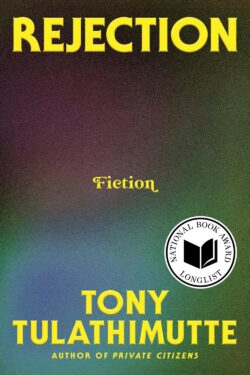
Rejection
Written by Tony Tulathimutte
Publication date: September 17, 2024
272 pages
ISBN: 978-0063337879
A finalist for the National Book Awards with an author rumored to have received a six-figure advance, Rejection by the Thai American writer Tony Tulathimutte is a short-story collection that features socially inept, amorous souls whose romantic ventures depict the tangled travesty of dating in our internet and smartphone era. The protagonist in each story is in turn narcissistic, megalomaniac, and pitiful. There is a tacit and sadistic pleasure in witnessing the humiliations and sufferings of others, which in comparison affirms that I am at least not in that desperate situation, and Rejection bestows on readers many such pleasures. (German has a word for this kind of pleasure: schadenfroth.)
In all stories, Tulathimutte’s writing is superb, ingeniously funny, and shamelessly direct in all matters sexual. Rejection begins with “Feminist,” a short story originally featured in the renowned magazine N+1 and garnered infamy for its “no-holds-barred” dealing with sensitive themes. It features a white heterosexual man with vexingly narrow shoulders. He can never attract a woman, is perennially “friend-zoned,” and loses his virginity at the “advanced” age of 31. Yet, he is a vocal feminist, a trait which all women are supposed to value in men. Here’s how his online dating profile reads: “He/him/his (or whatever pronouns you are most comfortable with). Unshakably serious about consent. Abortion’s #1 fan. … I can usually be found haunting the bookstores and bakeshops of our fair burgh, when I’m not dismantling the imperialist male supremacist hetero patriarchy. … Trans women are women, duh. All races, ethnicities, and body types–but NOT all ages–very welcome!” All the righteous sentiments are seemingly present, yet the person comes off as sanctimonious and even a bit freakish.
What Tulathimutte conveys here is the subtle irony of left politics, the discrepancy we ignore between what we profess ought to be and how our action speaks. The eponymous protagonist is resentful because, although left-oriented women ostensibly advocate for feminism, gender-equality, trans-rights, etc., they end up dating and marrying jerks. The story ends with a long, self-justifying letter composed by an ultimate incel.
The next story “Pics” features a white woman, Alison, in her late 20’s whose one-night stand with her best friend (male) turns into a soul-crushing obsession. However, her best friend soon begins a relationship with an Asian, a petite Korean girl whom Alison nonchalantly calls “a Filippina girl.” The significant portion of the story is conveyed in the form of a group text message between Alison and her girl-friends, sharing anecdotes and advice on dating. This reviewer had the most difficult time following the conversations due to the rampant use of millennial-savvy acronyms and slang.
The third story, enigmatically titled “Ahegao, or, The Ballad of Sexual Repression,” features a gay, Thai American man improbably named Kant, whose sexual fantasy is so grotesque that this reviewer had to skip pages where Kant details in writing the scenes to be filmed as he puts in an order for a custom-made porno, as no human being will ever submit to such a degrading trial in real sex. Kant has some traumatic pasts, as he recalls “…one of many reasons he’d gotten bullied, though it was for being Asian, not gay, that they called him gay.” He also harbors several misgivings about being gay and Asian at the same time, as he reflects, “…straight liberals who were secretly disgusted by gay sex, straight Asian guys who resented gay Asian guys for reinforcing the effeminacy stereotype, white gays who considered Asians effeminate.” Kant dates a white guy he meets at a gym, and their interracial relationship is fraught with misfired jokes and double consciousness.
Other stories feature similar protagonists equally self-absorbed and egoistic who turn their rejections into self-justifying hatred and petty actions. What’s missing in all these stories is any glimpse of a sustaining, monogamous relationship. No traditional family with children at all. Perhaps, this is the natural next step in our mating habits in an era perpetually steeped in the internet, where dating apps are the nexus of romantic relationships, where filter bubbles condition us all into narcissists who can’t and won’t accept another viewpoint. As someone who has never experienced modern romantic relationships as depicted in this book, this reviewer is unable to comment on its verisimilitude. Yet, Rejection offers many wry laughs and paradoxes of a millennial love life. And plenty of schadenfroth.
Review by Richard M. Cho, Research Librarian for Humanities & Literature at UC Irvine, with editing from Emily Espanol.
Book reviews and author interviews featured on APALAweb.org are reflective of the reviewer and interviewer only and are conducted separately from and independently of APALA and the APALA Literature Awards Committee and juries.
To submit your own book review, contact our Media and Publicity Committee, communications@apalaweb.org