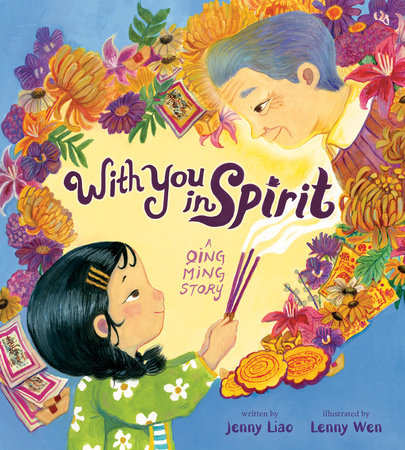
With You in Spirit
Written by Jenny Liao
Illustrated by Lenny Wren
Publication date February 24, 2026
40 pp.
ISBN: 9780593806975
In the West, graveyards conjure up darkness and sadness, and often something spooky and frightening. In Chinese culture, graveyards bring up memories of love, family, the wisdom they’ve imparted to us, as well as a continuation of care and connection with those who have passed on. This is what Qing Ming – which translates to Pure Brightness Festival – is about: A celebration of life and of loved ones who have departed, and the happy memories and life lessons that will forever hold space in our memories and in our hearts.
Jenny Liao’s book artfully tells the story of a young girl who shares memories of her Yeh Yeh (grandpa) on the journey to his grave. She recalls memories of riding their bikes to the park together, of his cheerful grin and laughter, of his voice and his gentle guidance in writing Chinese calligraphy. With each memory, she shares how much she misses those moments. As the family arrives at Yeh Yeh’s grave, she demonstrates how they care for him during Qing Ming by cleaning the “wilted leaves and… unwieldy weeds” (Liao, 2026, p.10), laying out his favorite foods, offering him the best pieces if siu yuk (BBQ pork), and thus returning the care he had given them during his lifetime. While sharing a feast of Yeh Yeh’s favorite foods, they also update him about their lives.
The day ends with the burning of joss paper, which are offerings of items that grandpa may need to thrive in the afterlife. The sweetest moment is when our young narrator offers what she treasures most: her fond memories of Yeh Yeh in the form of drawings of a shiny bike with two jingling bells and a calligraphy brush with an ink stick – ensuring that he has everything to be happy in the afterlife.
The story concludes with the young girl realizing that her grandpa will always be with her, as long as she keeps his memories alive. That is the essence of Qing Ming, to keep honoring those memories and to keep those memories alive by honoring and caring for loved ones, even after they’ve left this Earth.
I loved how the bright and whimsical illustrations complemented the story. The colors are the vibrant reds, yellows, and golds often associated with Qing Ming. The round dinner table, the red and gold Kitchen God Chinese calendar on the wall, and the pink thermos with the decorative rose remind me of the family kitchens from my childhood. The illustration of Yeh Yeh towards the end of the book characterizes him as a sunny spirit, surrounded by a warm halo, befitting the memory cultivated by the narrator. The “crackle, whoosh, and pop” sounds from the burning joss paper and the red cylindrical can used to burn the joss paper is something many Chinese Americans will recognize. The image of bright yellow fire leading to Yeh Yeh’s outreached arms, communicates well the idea of the transferring of the offerings from the family members to Yeh Yeh’s spirit.
I enjoyed how Qing Ming is revealed through the memories of a young girl, teaching readers what Qing Ming is and how and why it is celebrated. An author’s note in the back of the book explains what Qing Ming is – a holiday that is celebrated during the first week of April – and its importance in Chinese heritage. I also love the glossary of Cantonese words for titles of family members. This book is recommended to parents who’d like to impart their cultural heritage to their children, and to parents who’d like their kids to learn about different cultures and traditions.
Review by Liza Ly, with editing assistance by Emily Espanol.
Book reviews and author interviews featured on APALAweb.org are reflective of the reviewer and interviewer only and are conducted separately from and independently of APALA and the APALA Literature Awards Committee and juries.